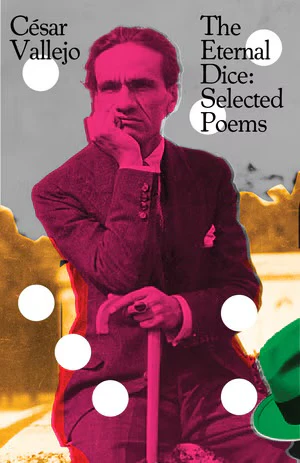
The Eternal Dice: Selected Poems (Bilingual Spanish and English)
Cesar Vallejo
The Peruvian poet César Vallejo—one of Latin America’s most famous poets—was involved in various literary circles and began publishing his poems in 1914 in magazines, after discovering the works of Walt Whitman, the French symbolists, and the modernist Nicaraguan poet Rubén Dario. He brought out his first book of poems in 1919, Los heraldos negros, and in 1922, he published his famous Trilce, which met a cool reception. Vallejo spent many years of his life in Europe—in Paris and Spain. Like many of the surrealists, he became a Marxist, and he was an ardent supporter of the Republican cause during the Spanish Civil War. In his poems, Vallejo poignantly describes human misery, isolation, and anguish. As the translator Margaret Jull Costa explains: “Vallejo edited and redrafted and honed his poetry. This is the only way in which he could describe the antithetical, paradoxical, oxymoronic universe he was living in, by using language at full tilt, making it perform all kinds of acrobatics. The resulting poems often defy interpretation…” This marvelous new bilingual selection of poems spanning his career up to his early death confirms Robert Hass’s assessment that Vallejo was “one of the essential poets of the twentieth century, a heartbreaking and groundbreaking writer.”
Product Information
Product Information
Shipping & Returns
Shipping & Returns
Description
Cesar Vallejo
The Peruvian poet César Vallejo—one of Latin America’s most famous poets—was involved in various literary circles and began publishing his poems in 1914 in magazines, after discovering the works of Walt Whitman, the French symbolists, and the modernist Nicaraguan poet Rubén Dario. He brought out his first book of poems in 1919, Los heraldos negros, and in 1922, he published his famous Trilce, which met a cool reception. Vallejo spent many years of his life in Europe—in Paris and Spain. Like many of the surrealists, he became a Marxist, and he was an ardent supporter of the Republican cause during the Spanish Civil War. In his poems, Vallejo poignantly describes human misery, isolation, and anguish. As the translator Margaret Jull Costa explains: “Vallejo edited and redrafted and honed his poetry. This is the only way in which he could describe the antithetical, paradoxical, oxymoronic universe he was living in, by using language at full tilt, making it perform all kinds of acrobatics. The resulting poems often defy interpretation…” This marvelous new bilingual selection of poems spanning his career up to his early death confirms Robert Hass’s assessment that Vallejo was “one of the essential poets of the twentieth century, a heartbreaking and groundbreaking writer.”